
Architecture & Monuments
Un palinsesto di civiltà tra Roma, Bisanzio e il Medioevo
On the outskirts of Decimoputzu stands the Church of San Giorgio (Saint George), a stone gem preserving centuries of layered history. This small building is much more than a Romanesque church: it is a palimpsest where Roman memory, Byzantine heritage, and Christian faith intertwine.
The first documentary reference dates back to 1089, when Constantine, Judge of Cagliari, confirmed the donation of the ecclesiam S. Georgii de Decimo to the Benedictine monks of Saint-Victor in Marseille. But its roots go much further back.
The Roman mosaics: reused memory
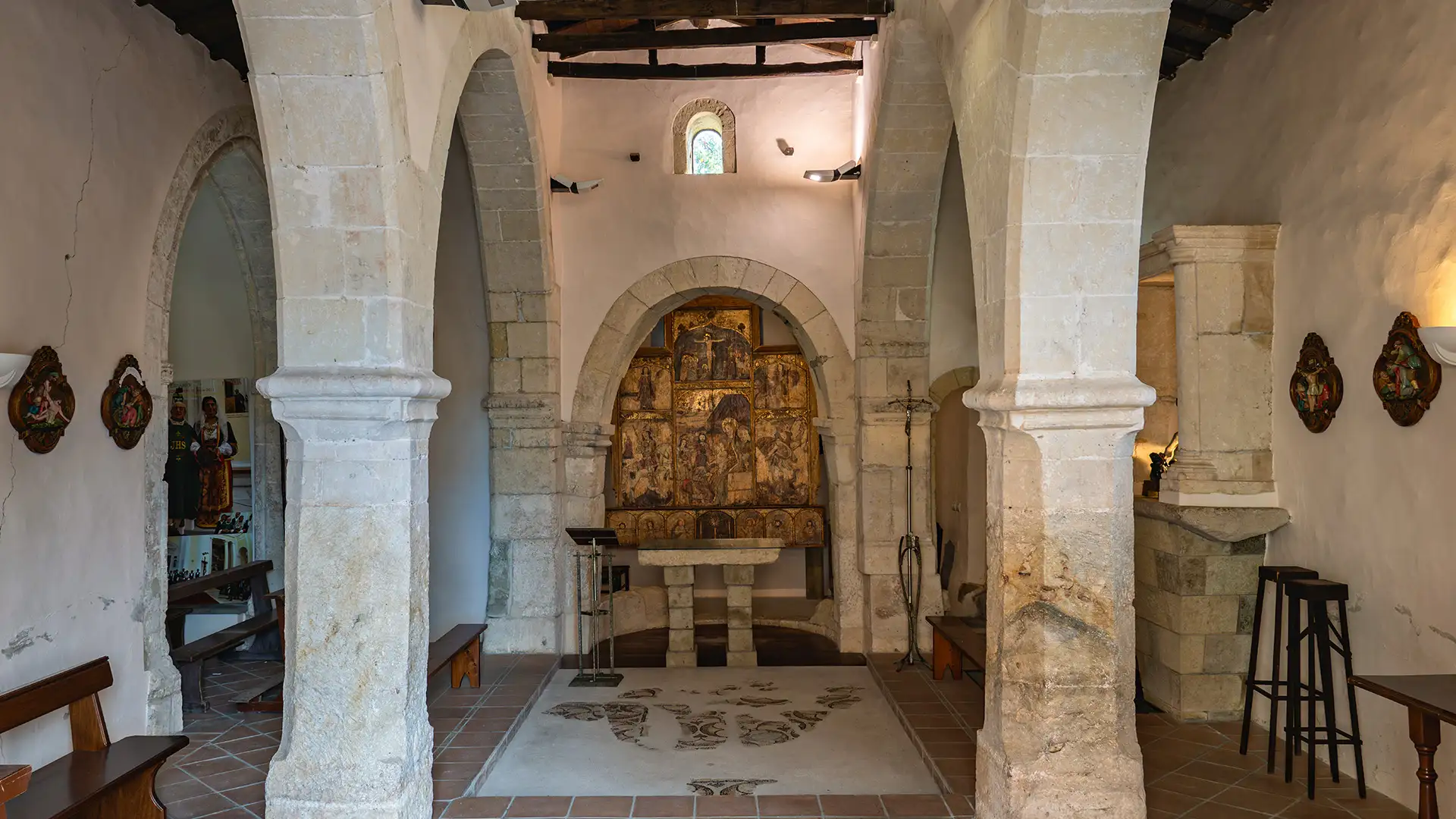
Excavations carried out in 1989 revealed a remarkable story. Beneath the Romanesque building, traces emerged of a 6th-century early Christian/Byzantine church, with a semicircular apse and baptismal font. The most extraordinary discovery was the floor, containing fragments of a 3rd-century Roman mosaic reused from an older public building.
A Roman inscription on limestone was also found nearby, while traces from the Final Bronze Age Nuragic period have emerged at Monte Sa Idda. This place was already a vital crossroads in antiquity.
Ciò che rende unica San Giorgio è questa pratica del riuso: tessere di un mondo pagano trasformate in pavimento sacro, che attraversano i secoli cambiando significato ma conservando la loro bellezza.
The Byzantine tomb
At the rear of the church, during the 1989 restoration works, a hypogeal tomb with a barrel vault was discovered, dating to the Byzantine period. Although it is now only partly visible, it remains a precious testimony to that period of transition between the Roman world and the Middle Ages.
From Romanesque to Gothic
L’edificio attuale è frutto di trasformazioni successive. La facciata in conci di calcare presenta un portale architravato sormontato da un arco a tutto sesto e una bifora divisa da colonnina in basalto. Sugli spioventi si eleva un campanile a vela a due luci, secondo lo stile dei monaci Vittorini.
Between the 15th and 16th centuries, during the Late Gothic period, a chapel was built with a refined lobed window. The interior, with three aisles separated by pointed arches, preserves a priceless Late Gothic retable: a double triptych depicting the Crucifixion, the Adoration of the Magi, San Giorgio as a knight, and San Michele Arcangelo (Saint Michael the Archangel). A 17th-century statue of San Giorgio on horseback is kept in a shrine.
San Giorgio the Great Martyr
San Giorgio, “Grande Martire” della Chiesa cristiana, nacque in Cappadocia tra il 275 e il 285. Soldato dell’imperatore Diocleziano, donò i suoi beni ai poveri e dichiarò apertamente la sua fede. Fu decapitato a Nicomedia il 23 aprile del 303.
According to legend, he saved a princess from the dragon of Selem in Libya, piercing it with his lance: a symbol of faith triumphing over evil.
Santa Assuina, Sardinian martyr
Alongside San Giorgio, Decimoputzu also venerates Santa Assuina (Saint Assuina), also known as Santa Suia or Santa Sofia. According to local tradition, she was a young martyr from Cagliari who lived at the end of the 3rd century. Born into a noble family, she bore witness to her Christian faith with extraordinary courage at the fervent age of fifteen. Tried by the Roman authorities because she was Christian, she became a victim of Diocletian’s persecution and died a martyr together with two companions: Cecilia and Ginia.
Le sue reliquie sono custodite nella cripta della Cattedrale di Cagliari insieme alla grande schiera di testimoni della fede cristiana in Sardegna. Una chiesa dedicata a Santa Suia sorgeva tra Decimoputzu e Villasor, ma si dice che fu distrutta nel 1782. Alcuni frammenti furono ritrovati nel 1844 e la sua statua è oggi custodita nella Chiesa di San Giorgio, dove la giovane martire continua a essere venerata dalla comunità.
The feast
On the third Sunday of May, the village celebrates San Giorgio and Santa Assuina with the procession of the statues, the distribution of blessed bread, and solemn Mass in front of the church.
Visitor information
Opening hours: The church is generally closed. To arrange a visit, please contact the Municipality of Decimoputzu.
Is something wrong with this point of interest? Send us a report.