
Architecture & Monuments
A journey through two thousand years of history, from Roman baths to an early Christian baptistery and Marian devotion
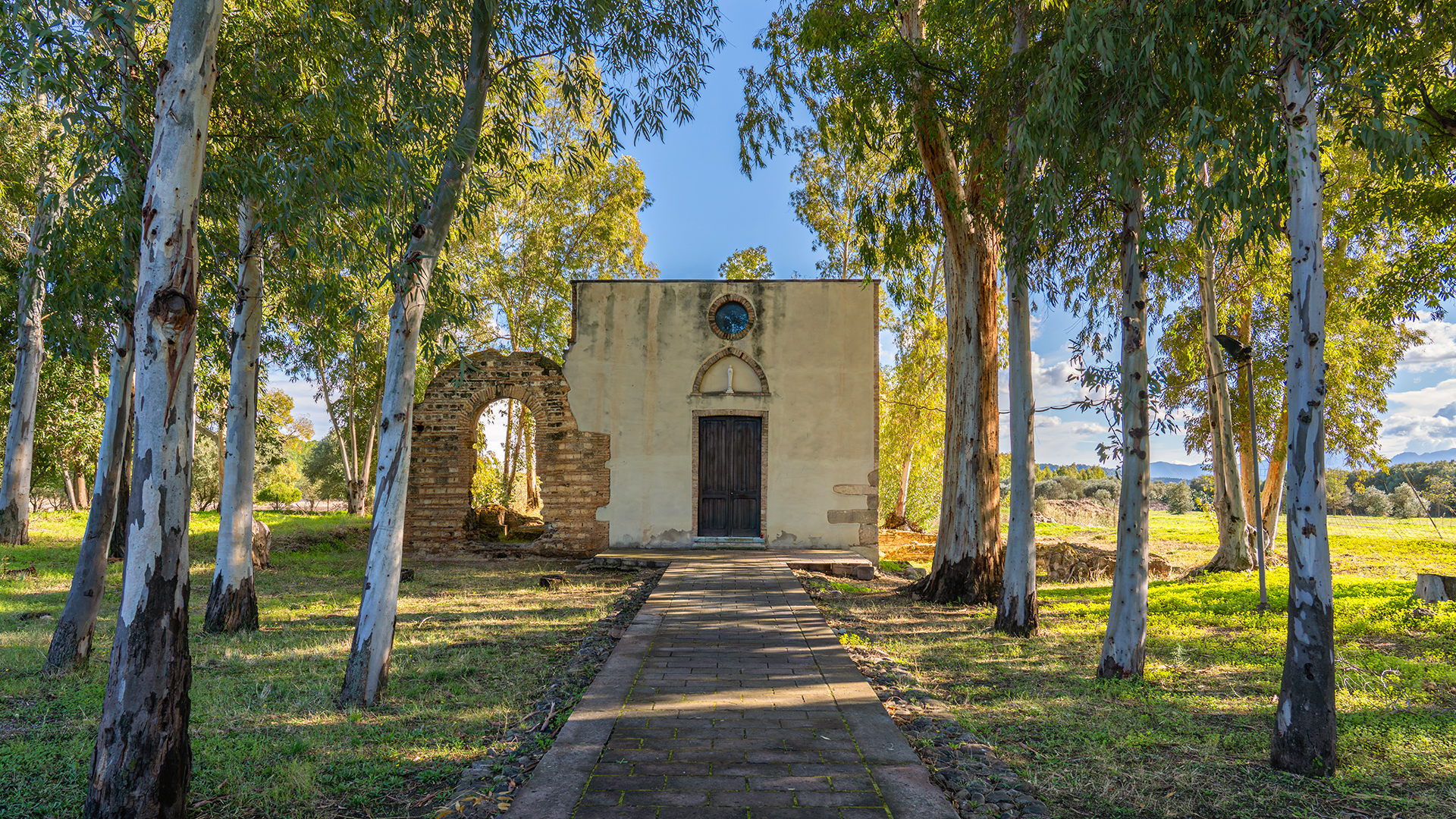
On the outskirts of Vallermosa, the Church of Santa Maria di Paradiso (Saint Mary of Paradise) stands on a place that people have regarded as sacred for almost two thousand years.
Beneath the foundations of this rural church lie the remains of a Roman bath complex, transformed into a Christian place of worship as early as the 4th century. It is a unique site, where archaeology, history, and faith intertwine in an extraordinary way.
Here, where the Romans once sought physical wellbeing in the warm waters of the baths, the first Christians found a place to purify the soul. And still today, every year, the community of Vallermosa gathers to celebrate the Virgin Mary, renewing a tradition that has crossed the centuries.
The Roman Baths: an Imperial-era complex
The bath complex was probably built between the 2nd and 3rd centuries AD, as part of a Roman villa. The building technique is typical of the Imperial period: opus vittatum mixtum, characterised by alternating rows of bricks and small tuff blocks. It is believed that the rooms were originally covered by barrel vaults.
The complex was supplied with water from a nearby well through a hydraulic system that is still well preserved today, complete with terracotta pipe drains.
Excavations, begun in the 1960s by the local priest Antonino Figus and resumed in 2000 by a team of archaeologists, brought several rooms to light: the apodyterium, the entrance room where people undressed; the frigidarium, with two basins for cold baths; and the foundations of the calidarium, the area intended for hot baths, with the cavity for the passage of hot air and the mouth of the furnace used for heating.
The transformation into a Christian place of worship
A partire dal IV secolo, le terme vennero abbandonate e gradualmente trasformate in luogo di culto cristiano. Gli scavi più recenti hanno riportato alla luce una scoperta significativa: un battistero a forma di conchiglia, provvisto di gradino per agevolare l’immersione dei battezzandi. Una testimonianza preziosa della diffusione del cristianesimo in questa zona della Sardegna.
In 1089, Constantine Salusio II, Judge of Càlari, donated the church to the Victorine monks of Marseille, who cared for it until its abandonment around 1180. The building fell into ruin several times and was rebuilt just as many times, until its 17th-century reconstruction under Spanish rule, when it was dedicated to Nostra Signora di Monserrato (Our Lady of Montserrat).
L’architettura della chiesa attuale
The façade is simple, with a flat top. At the centre is a framed portal, preceded by two steps and surmounted by a lunette niche containing a small statue of the Virgin Mary. A distinctive glazed oculus lights the upper part of the façade.
L’interno, essenziale e raccolto, è costituito da un’aula a navata unica. Finestre laterali illuminano lo spazio, dove nicchie ospitano statue devozionali. Nell’area presbiteriale, leggermente rialzata, l’altare è coronato da una nicchia che custodisce l’antica e veneratissima statua della Vergine con Bambino.
The Feast of Santa Maria
Every year, on 8 September, Vallermosa celebrates the Feast of Santa Maria with a ritual that involves the whole village. On the previous day, the statue of the Virgin is carried in procession from the parish church to her rural church. After the religious ceremonies, the statue returns to the village in a reverse procession, and on the following day it is carried through the streets of the town.
Visitor information
Opening hours: To arrange a visit, please contact the Municipality of Vallermosa. The Roman baths adjacent to the rural Church of Santa Maria are accessible and freely open to visitors.
Recommended period: 8 September, during the Feast of Santa Maria.
Is something wrong with this point of interest? Send us a report.